AGENTIC AI PATTERNS
Created IBM's first Agentic AI interaction patterns
*short case-study
design-led discovery
cross-product integration
Teams
Kochi AI guild, Carbon for AI
Role
Core design contributor
Duration
4 months
Background
In September 2024, Chris Noessel (co-author of About Face, author of Designing Agentive Technology) visited IBM's Kochi studio for an agentic AI workshop. This sparked the AI Guild East Chapter—a Kochi team tasked with creating interaction patterns for agentic AI that would be used across IBM's AI product portfolio.
The challenge was unprecedented: agentic AI was so new that no design patterns existed. Competitors had nothing to reference. We had to invent from scratch. Our directive from Adam Cutler (Agentic Design Initiative head at IBM): release first, iterate later.
I worked as a core design contributor alongside Sumesh Somarajan (lead), Milin Ann, Indhu Priya, and Drron Sharma. We created personas (Bob the builder, Cassie the business user), explored how agents would be built and used, and designed everything from plans and reasoning traces to trajectories, versioning, plan repositories, and running dashboards.
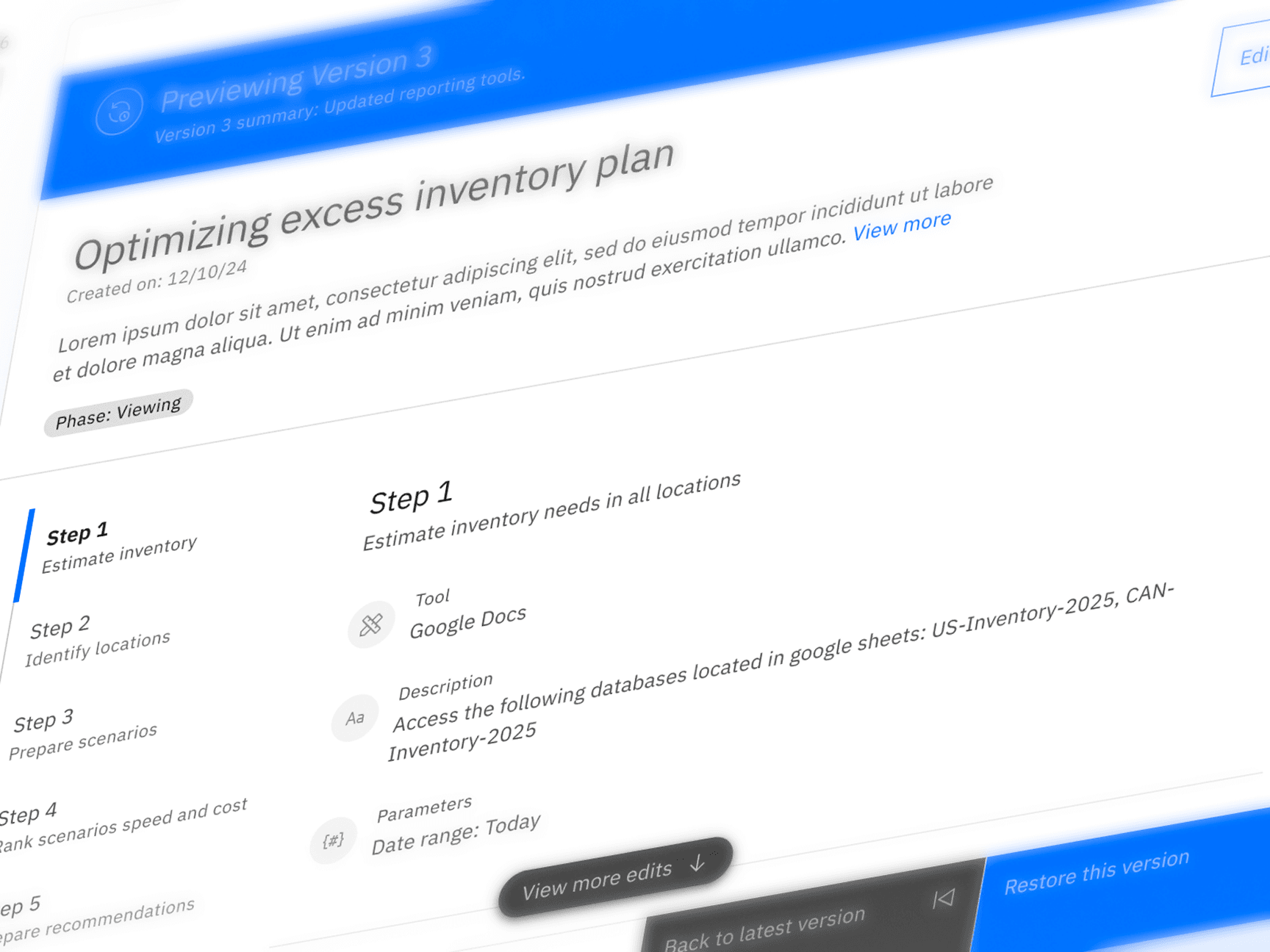
The breakthrough: Treating plans as versioned objects with a clear endpoint. During team discussions I led about versioning, I realized there's a Plan 0 that evolves into Plan X (the optimal, reusable plan). All versions in between exist to reach that ideal state. I designed initial and refined versioning concepts that Chris Noessel reviewed and approved before his departure from IBM, though a simpler version was ultimately implemented by the Carbon team.
The East Guild's primary contributions—which I was core to—were the reasoning trace and Plan (Workspace) component patterns. Our first iteration was signed off by Justin Youngblood (VP of PM and Design at the time). By the end, we collaborated with Carbon Design teams to convert our UX patterns into reusable components for the Carbon for AI library.
Today, our agentic patterns are used internally by agentic AI designers across IBM, particularly in Data & AI products.
Key Outcomes
Patterns now used across 10+ IBM agentic AI products
Particularly in Data and AI portfolio, with Carbon for AI components awaiting public release
Core contributor to reasoning trace and Plan (Workspace) patterns
East Guild contributions now part of Carbon for AI library
Featured on IBM's Design for AI internal page
Agentic AI section founded by Adam Cutler and Hal Wuertz
Delivered in 4 months
From workshop kickoff to patterns used internally by IBM agentic designers
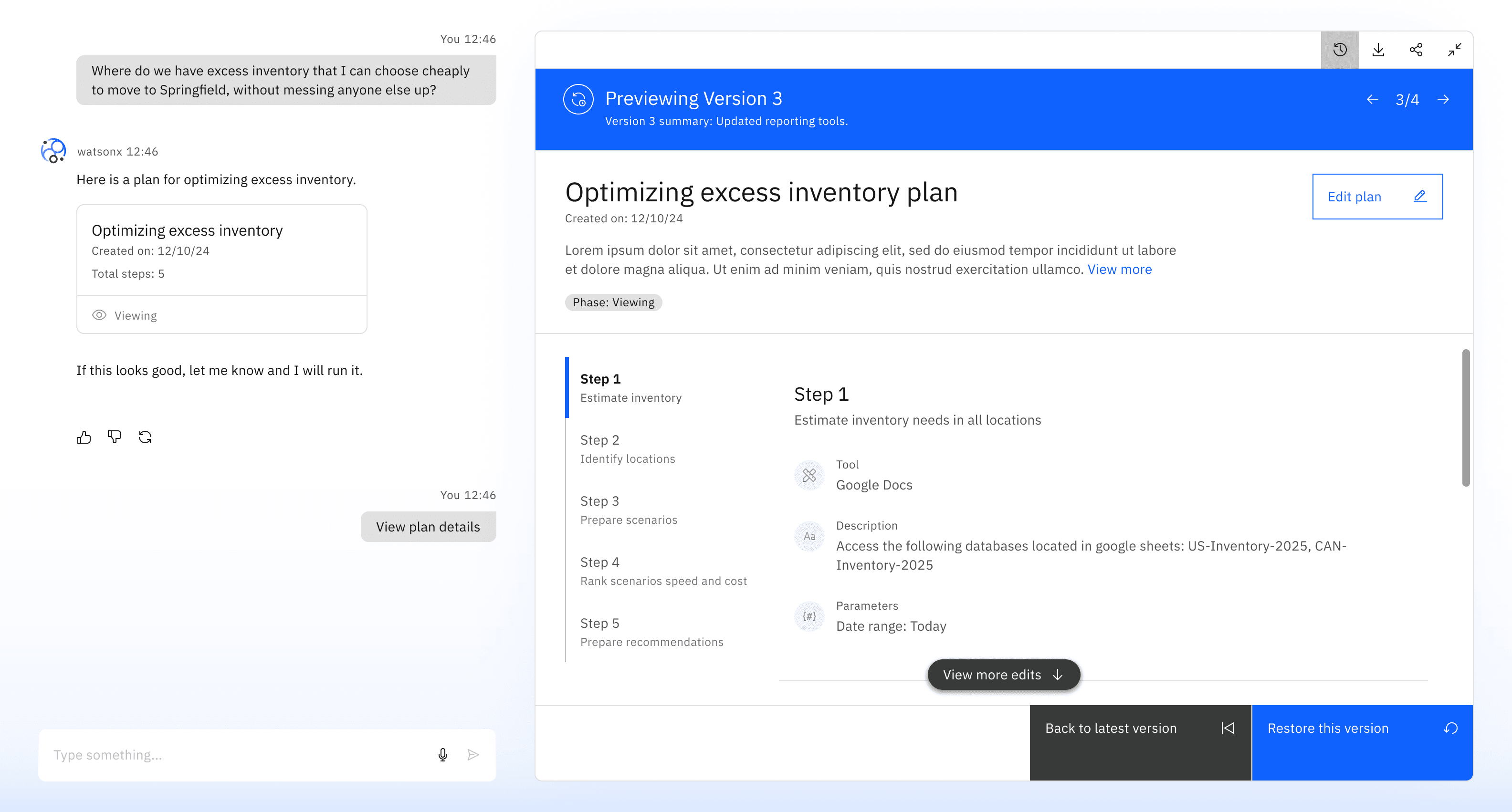
Plan editor workspace: Versioning view
Design challenges
Designing for uncharted territory without references
Agentic AI was so new that no design patterns existed—not from competitors, not from research. We had to innovate from first principles. Every concept (plans, reasoning traces, trajectories, versioning) required us to talk through ideas and validate internally.
We used 3-minute sketches to explore concepts fast—each team member would sketch different approaches to the same problem, then we'd critique and synthesize the best ideas. This let us explore 10+ concepts in an hour instead of spending days on polished mockups. The pace was intense—late evening brainstorming sessions at the office—because the directive was clear: release first, iterate later.
Establishing plans as recognizable objects across contexts
Plans needed to function as objects users could recognize in different forms—a plan preview in chat looks different from a plan in edit mode. I used Task-Object-Model thinking to ensure users understood what a "Plan" was regardless of context. I fought to have plans include version numbers every time they appeared in chat so users wouldn't confuse which plan the surrounding text referenced—critical for both usability and auditability.
Adapting patterns across wildly different product constraints
Our patterns needed to work across products with completely different real estate. Watson Code Assistant, for example, is a VS Code plugin constrained to a side panel. Other products had full-screen canvases. I had to design patterns flexible enough to scale up or down while maintaining consistency. This meant thinking in systems—not just "what does a plan look like," but "what does a plan look like in 200px vs 1200px."
Converting UX patterns to Carbon components fast
We needed to move quickly so the Carbon Design team could "Carbonize" our designs and create final components for the Carbon for AI library. This meant designing with Carbon's design system constraints in mind while still pushing for innovation. Balancing speed with quality and ensuring our patterns could translate into reusable components.
The broader impact
Our work established the foundation for how IBM designs agentic AI products. Before this, no patterns existed—teams were building in silos, creating inconsistent experiences. By creating patterns that adapted across wildly different constraints (Watson Code Assistant's 200px VS Code panel to full-screen canvases), we enabled product teams to ship agentic features consistently and quickly.
The reasoning trace and Workspace patterns we contributed are now core to Carbon for AI. This means future IBM agentic products won't start from zero—they'll build on patterns we validated, tested, and refined. We designed in uncharted territory where competitors had nothing to copy, delivering fast enough to enable product teams while maintaining quality for Carbon integration.
We proved agentic AI could follow systematic design patterns instead of being reinvented product-by-product. This saves IBM teams months of exploration and ensures customers get consistent agentic experiences across the portfolio.